
Researching the Mind. Measuring Performance. Advancing Human Potential.
From peer-reviewed scientific foundations and real-world experimentation to AI-assisted mental performance, wearable physiology and the future of non-invasive brain–computer interfaces.
The Science Behind Bmotion®
Bmotion® draws on research in neuroscience, cognitive psychology, motor learning and human performance to explore how the brain influences movement, decision-making and skill development. Our research examines mental rehearsal, attention, psychological regulation, neuroplasticity and feedback-driven learning, connecting established scientific findings with real-world experimentation and emerging technologies. These foundations inform our hypotheses and technology development, while our proprietary approaches remain subjects for further investigation and validation.
Neuroscience & Neuroplasticity
The brain continuously adapts in response to experience, learning and practice. Research into neuroplasticity explores how neural pathways change as skills develop, while studies of motor imagery and mental rehearsal investigate how cognitive processes contribute to movement preparation and performance. These scientific foundations inform Bmotion’s exploration of brain-led skill development.
Cognitive Psychology & Mental Performance
Performance is influenced not only by physical ability, but also by attention, emotion, confidence and decision-making. Research in cognitive psychology and sports performance examines how mental routines, psychological regulation and attentional control can support consistency under pressure. These insights inform Bmotion’s development of AI-assisted mental performance tools, including LOOPER®.
Motor Learning & Feedback
Developing physical skills involves more than repetition. Research into motor learning examines how practice structure, feedback, reflection and experience influence skill acquisition and retention. These principles inform Bmotion’s exploration of personalised learning systems that connect movement data, psychological insights and iterative feedback to support more effective practice.
Blueprints for a Healthier World®
Project Swing Track — A Living Laboratory
Established in October 2025, Project Swing Track began with a simple idea: could a low-cost backyard golf laboratory become a blueprint for healthier living and more effective learning?
Built for approximately $500, the home putting green and driving range created an accessible environment for daily experimentation, practice and physical activity. Beyond reducing costs and travel, the laboratory brings together five important dimensions: affordability, accessibility, continuous experimentation, family participation and healthy daily routines.
Project Swing Track explores how learning, movement and technology can become part of everyday family life — supporting the broader Bmotion® vision of Blueprints for a Healthier World®.
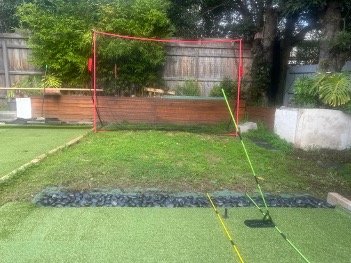
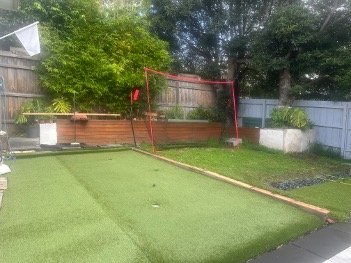
Five Dimensions of a Healthier World
Affordability: Established for approximately $500, the home laboratory demonstrates how meaningful experimentation and regular physical activity can begin without expensive facilities or memberships.
Accessibility: Having a putting green and driving range at home removes travel barriers and makes short, frequent practice sessions possible throughout the week.
Experimentation: A familiar, readily available environment supports repeated testing, performance measurement, reflection and continuous learning.
Family Participation: The backyard becomes a shared space where family members can participate in physical activity, practise skills and learn together.
Healthy Daily Living: By integrating enjoyable movement into everyday life, Project Swing Track explores how recreational practice can complement or replace parts of a conventional exercise routine.
Real-World Experimentation & Measurable Progress
Project Swing Track provides an ongoing opportunity to explore how accessible practice, structured experimentation and feedback-driven learning may influence skill development and everyday wellbeing.
Golf Handicap: 36 → 19
During the Project Swing Track journey, the founder’s reported golf handicap improved from 36 to 19, representing a 17-stroke reduction.
Playing Less, Learning More
Over the broader learning journey, golf-course participation decreased from approximately three rounds per week at one course to three rounds per month across a variety of courses. Meanwhile, the home laboratory provided opportunities for regular practice, experimentation and reflection.
An Observational Case Study
These results represent personal longitudinal observations, not a controlled scientific trial. Multiple factors may have contributed to the improvement, and the findings do not establish that Project Swing Track or any particular technology caused the change.
The experience nevertheless provides a practical foundation for developing research questions about learning efficiency, accessibility, performance and healthy daily routines.
The Home Laboratory — Tools, Data & Experimentation
Today’s Research Infrastructure
Project Swing Track already brings together four complementary sources of information:
Launch Monitor: Measures golf performance through indicators such as club speed, ball speed, launch characteristics, carry distance and shot dispersion.
Apple Watch: Provides physiological and activity measurements, including heart rate, exercise duration and movement-related information.
On-Course Performance Tracking: Records golf performance across different courses, supporting comparisons between practice and real-world play.
Player Observations: Captures personal reflections, perceived mental states, routines, environmental conditions and learning experiences.
These existing capabilities provide the practical data foundation for LOOPER® V3, which aims to integrate physiological, performance and player-reported information into a more personalised AI-assisted learning system.
Looking further ahead, Humome® explores the potential of non-invasive brain–computer interfaces to incorporate neural sensing into this framework. While EEG-based sleep-monitoring technologies already exist, reliable interpretation and correlation of brain signals with performance, physiology and subjective experience remain future research objectives.
PAIP-D™ & Neuroloop
The Science of Learning Through Experience
Bmotion® explores a fundamental question: how do perception, thought and experience influence movement, performance and learning?
Our proposed PAIP-D™ framework examines the cognitive processes associated with preparing for and executing movement, while Neuroloop describes the recurring cycle through which experience, feedback and reflection can inform future actions.
Together, these complementary concepts provide a framework for investigating how human learning might be supported by personalised AI, physiological measurements and, eventually, non-invasive neural sensing.
Both are evolving Bmotion® research models informed by established scientific disciplines. Their specific structures and applications require further empirical investigation and validation.
PAIP-D™
From Perception to Learning
PAIP-D™ is Bmotion’s proposed framework for exploring how cognitive processes influence movement and how experience contributes to learning.
Perception → Attention → Intention → Prediction → Decision → Motion → Feedback → Neuroplasticity → Automation
The framework begins with how we perceive our environment, direct attention, form intentions and anticipate outcomes before making decisions and executing movement.
Feedback from the resulting experience can inform subsequent decisions and practice. Over time, repeated learning experiences may contribute to neural adaptation and increasingly automatic skill execution.
PAIP-D™ is a conceptual research model, not a scientifically established sequence of neurological events. Its purpose is to guide investigation into brain-led learning and performance.
Neuroloop
Physical Practice to Digital Learning
Neuroloop — The Digital Learning Vision
Neuroloop is the learning concept underpinning LOOPER®, exploring how feedback, reflection and personalised digital experiences could support skill development and neuroplasticity.
Today — Learning Through Feedback
LOOPER® explores how guided mental routines, player observations and AI-assisted interpretation can support psychological preparation, reflection and performance.
Tomorrow — Personalised Digital Learning Loops
The next ambition is to combine mental rehearsal, AI, physiological measurements and performance data to create personalised digital learning experiences that adapt to individual needs.
The Future — Learning Beyond Physical Repetition
Our long-term research hypothesis is that carefully designed digital experiences may stimulate learning-related neural adaptation and eventually substitute for selected elements of physical practice.
The ultimate ambition is to investigate whether people can learn more effectively while reducing the time, cost and physical demands associated with repetitive training.
These proposed neuroplasticity benefits and physical-practice substitution capabilities remain research objectives requiring scientific validation.
Research Library
Physical Practice to Digital Learning
Bmotion® is committed to exploring the scientific foundations of human learning, movement and cognitive performance.
Our Research Library brings together published scientific studies, expert perspectives and original Bmotion® research documents, including findings and observations from Project Swing Track.
These resources inform our investigation into attention, mental rehearsal, neuroplasticity, motor learning, physiological measurement and emerging brain–computer interfaces.
We distinguish established scientific findings from our own experimental observations, conceptual frameworks and future research hypotheses. Our objective is to build a transparent, evidence-informed foundation for developing technologies that may improve learning, performance and everyday wellbeing.
Scientific Publications
Mental Fatigue in Golf: A Systematic Review
Pan et al. (2025) | PLOS ONE
A review examining research into mental fatigue in golf and its relationship to performance. Relevant to Bmotion’s investigation of attention, psychological demands and mental preparation.
Read the published study: https://doi.org/10.1371/journal.pone.0310403
Random Practice and Motor Learning
Fazeli et al. (2017)
This research investigates how practice organisation influences motor learning and skill retention. It contributes to the scientific foundation for Project Swing Track’s experimentation with practice routines and Bmotion’s longer-term exploration of personalised learning.
Research relevance: Practice structure, skill acquisition, retention and feedback-driven learning.
Read the published study: https://doi.org/10.1177/0031512517704106
EEG Alpha Activity and Relaxation
Mikicin & Kowalczyk (2015)
This research examines EEG alpha activity in relation to relaxation and psychological processes. It provides background for Bmotion’s interest in non-invasive neural sensing and the potential relationship between brain activity, mental states and performance.
Research relevance: EEG, relaxation, neurophysiology and future brain–computer interface research.
Important distinction: EEG measurements do not independently provide a reliable reading of a person’s thoughts or complex psychological states.
Read the published study : https://doi.org/10.1007/s10484-015-9290-0
Expert Perspectives & Insights
Tiger Woods — Mental Preparation & Pre-Shot Routines
Tiger Woods’ approach to golf highlights the importance of mental preparation, visualisation, commitment and consistent pre-shot routines.
His experience provides a practical perspective on how attention and psychological preparation can influence performance under pressure.
Research relevance: Mental rehearsal, attentional control, pre-shot routines and performance consistency.
These insights inform Bmotion’s exploration of personalised mental preparation through LOOPER®. They represent professional experience rather than scientific validation of Bmotion’s technology.
Mental Game by Tiger Woods : https://youtu.be/hjoIPI1pnns?si=tNS1BlYQ5dELY2lI
Brad Faxon — Confidence, Instinct & Putting Performance
Professional golfer and putting specialist Brad Faxon emphasises the importance of confidence, instinct and simplicity when preparing to execute a putt.
His approach provides a practical perspective on reducing excessive conscious control and developing consistent mental routines.
Research relevance: Confidence, attentional focus, putting psychology and automatic skill execution.
These perspectives inform Bmotion’s exploration of mental preparation and personalised digital learning through LOOPER®. They represent professional experience rather than scientific validation of the technology.
Mental Game by Brad Faxon : https://youtu.be/VzbrwSHF52o?si=uovjMwBAIi2bw3rO
Dr Brett McCabe — Performance Psychology & Mental Resilience
Sports psychologist Dr Brett McCabe explores how athletes manage expectations, pressure, emotional responses and attention during competitive performance.
His perspectives highlight the importance of understanding individual psychological patterns rather than relying on a single mental strategy for every athlete.
Research relevance: Performance anxiety, emotional regulation, attentional control and personalised mental routines.
These insights are relevant to LOOPER®’s development of individualised mental-performance interventions. They represent expert perspectives, not scientific validation of Bmotion’s technology.
Mental Game by Brett McCabe : https://youtu.be/du-8X8xI2p8?si=1GWbDZY69AUHDzvK
Dr Sahar Yousef — The Neuroscience of Focus, Learning & Human Performance
Neuroscientist Dr Sahar Yousef explores how attention, neuroplasticity, sleep and technology design influence human performance. Her insights offer valuable context for Bmotion®’s research into mental preparation, cognitive learning and biology-informed technology.
Bmotion® Original Research
Project Swing Track — The Origins of Bmotion®
Established in October 2025, Project Swing Track began as a low-cost backyard golf laboratory designed to explore learning, performance and healthier everyday living.
The project combines regular experimentation, launch-monitor measurements, Apple Watch activity and physiological data, on-course performance tracking and personal observations.
Its broader purpose extends beyond golf: investigating how accessible home environments can encourage continuous learning, family participation, daily physical activity and reduced dependence on expensive training facilities.
Blueprints for a Healthier World®
Project Swing Track helped shape Bmotion’s wider vision of combining neuroscience, technology and accessible learning environments to improve human performance and wellbeing.
The project represents ongoing exploratory research and personal observations rather than a controlled clinical or scientific trial.
The Bmotion® Model — Foundational Research Papers (August 2026)
Two foundational papers document the evolution of Project Swing Track from a backyard golf experiment into a broader research framework for human learning, movement and wellbeing.
1. Golf AI Tech Australia — Category Creation Paper / Fact Sheet
An introductory document outlining the project’s origins, home laboratory, research approach and emerging technology concepts.
2. Golf AI Tech Australia — A Category Creation Paper on the Bmotion® Model
A more detailed exploration of the project’s development, including Project Swing Track, performance measurement, the Bmotion® philosophy and its proposed learning frameworks.
Together, these papers provide a historical record of the ideas that informed Bmotion’s current technology roadmap.
Research status: Original conceptual and exploratory documents, not independently peer-reviewed validation studies.
PAIP-D™ & Neuroloop — Emerging Research Frameworks
Bmotion® has developed two complementary conceptual frameworks to guide its investigation into brain-led learning and human performance.
PAIP-D™ explores the relationship between perception, attention, intention, prediction, decision-making, movement, feedback, neuroplasticity and automation.
Neuroloop, the learning concept underpinning LOOPER®, explores how experience, feedback and personalised digital learning loops might support neural adaptation and skill development.
The longer-term ambition is to investigate whether digitally supported learning can reduce or replace selected elements of physical practice, potentially improving accessibility and learning efficiency.
Research status: Original Bmotion® hypotheses and evolving conceptual frameworks. Their proposed mechanisms and outcomes require empirical testing and independent scientific validation.
Request Access to Bmotion® Original Research
Bmotion® welcomes enquiries from researchers, clinicians, technology developers, educators and individuals interested in the future of human learning and performance.
Our original research documents explore the development of Project Swing Track, the Bmotion® Model, PAIP-D™ and Neuroloop, including our experimental observations, conceptual frameworks and future research directions.
To request access to these documents, please complete the form below. We will review your enquiry and contact you by email regarding access to the requested materials.
We welcome opportunities for research collaboration, scientific evaluation and interdisciplinary discussion.
Today’s Research Tomorrow’s Neurotechnology
Bmotion® is developing a long-term research pathway connecting human performance, artificial intelligence, physiological measurement and emerging neurotechnology.
Our journey begins with Project Swing Track and the existing LOOPER® prototype, progresses toward personalised digital learning through LOOPER® V3, and ultimately explores non-invasive brain–computer interfaces through Humome®.
The ambition is to move beyond simply measuring performance toward understanding how people learn — and investigating whether personalised digital experiences can support neuroplasticity, reduce the need for physical repetition and make learning more accessible.
Each stage builds on existing capabilities while recognising that future technologies and proposed benefits require further development and scientific validation.
TODAY — Research & Experimentation
Project Swing Track — An Active Home Laboratory
Established in October 2025, Project Swing Track provides an accessible environment for regular experimentation, physical activity and performance learning.
Existing Measurement Capabilities
Launch-monitor data, Apple Watch physiological and activity measurements, on-course performance tracking and player observations are already available to support experimentation.
LOOPER® — Current Prototype
LOOPER® explores AI-assisted interpretation of player-reported psychological states and personalised pre-shot interventions, including breathing, attentional focus and mental preparation.
Research Foundation
Published scientific literature, expert perspectives and original Bmotion® research inform the development of PAIP-D™ and Neuroloop.
These activities establish a practical foundation for future research, although the proprietary frameworks and interventions have not yet undergone formal scientific validation
TOMORROW – LOOPER® V3: Personalised Digital Learning
Integrating Existing Technologies
LOOPER® V3 aims to bring together Apple Watch physiological measurements, launch-monitor performance data, on-course tracking and player-reported experiences within a unified AI-assisted learning system.
Personalised Mental Performance
By analysing patterns across these information sources, V3 will explore personalised mental preparation, adaptive interventions and feedback tailored to individual players.
From Feedback to Digital Learning Loops
Building on Neuroloop, the longer-term objective is to develop personalised digital experiences incorporating mental rehearsal, reflection and adaptive guidance to support skill development.
Research & Validation
V3 will provide opportunities to investigate relationships between psychological experiences, physiological signals and performance outcomes. Proposed benefits for learning efficiency and neuroplasticity will require controlled scientific evaluation.
Development status: Planned integration and research capabilities, not currently validated features of the LOOPER® prototype.
FUTURE — Humome®: Non-Invasive Brain–Computer Interfaces
Beyond Wearables — Towards Brain Sensing
Humome® represents Bmotion’s long-term research vision for non-invasive brain–computer interfaces (BCIs), exploring how neural activity could contribute to a deeper understanding of human learning and performance.
Building on Existing EEG Technology
Non-invasive EEG technologies already measure electrical activity associated with brain function, including signals used in sleep research and monitoring. Humome® aims to investigate how future wearable neural sensors might extend these capabilities into everyday learning environments.
Connecting Brain, Body & Performance
Our ambition is to investigate relationships between neural signals, Apple Watch physiological measurements, launch-monitor performance data and individual experiences.
The Future of Digital Neuroplasticity
Building on PAIP-D™ and Neuroloop, Humome® will explore whether brain-informed digital learning experiences could support neural adaptation and potentially reduce the physical repetition required for selected skills.
Research status: Humome® is a long-term exploratory concept. Reliable interpretation of complex mental states, integrated neural sensing and the proposed learning benefits require substantial research, development and scientific validation.